A floating log may appear harmless in the open sea, but for a small fishing vessel it can represent a serious navigational hazard. Once an accident occurs, currents and waves become equally important because they can carry people, vessel debris, and other floating material away from the accident location.
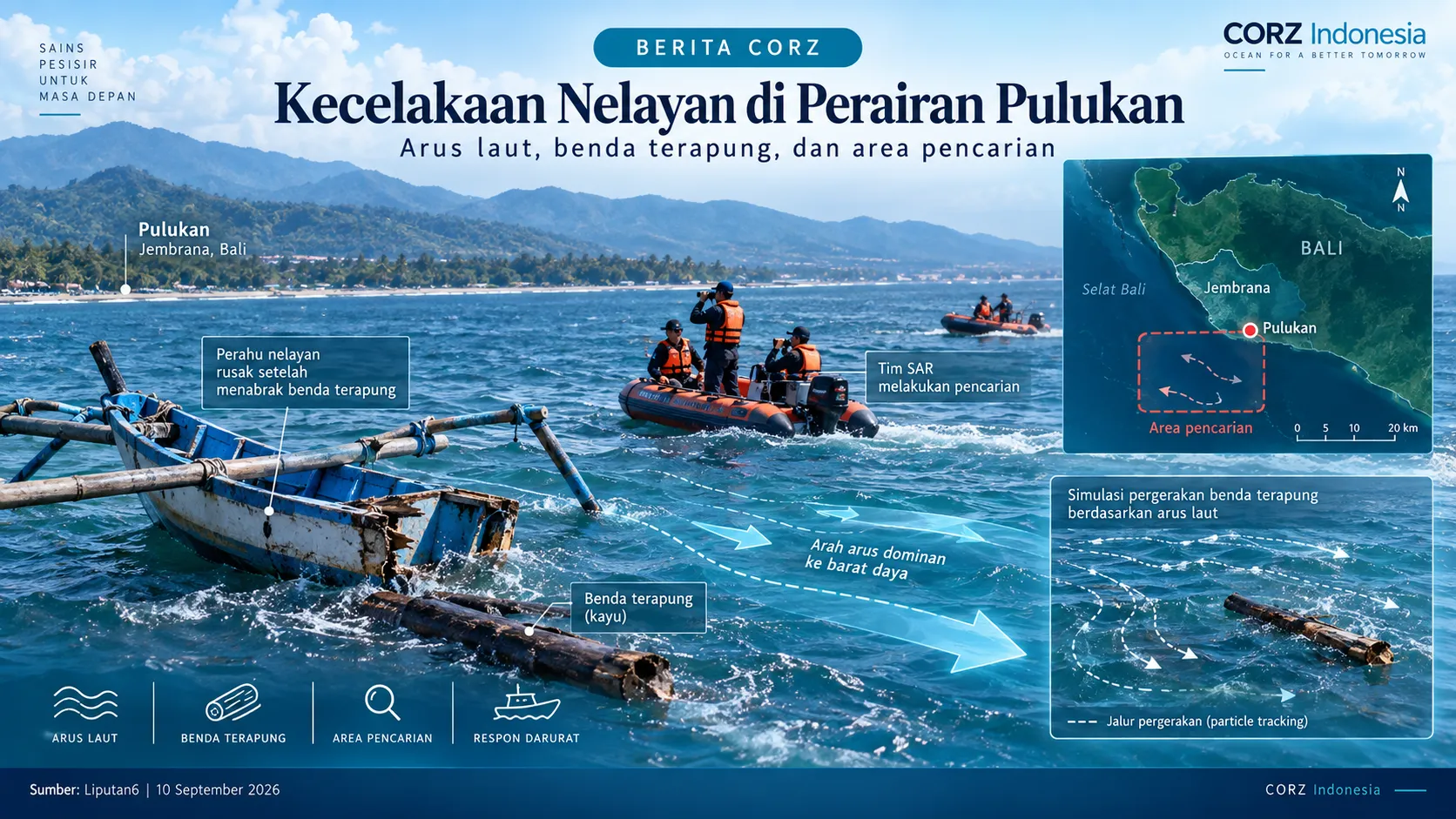
Liputan6 reported an accident on 10 September 2026 in the waters off Pulukan, Pekutatan District, Jembrana Regency, Bali. A fibre fishing canoe carrying three fishermen was damaged after colliding with a floating log.
Two fishermen were rescued, while one was reported missing after being swept away by the current. Search and rescue teams subsequently conducted searches from the location where the missing fisherman was last seen and expanded the search toward Pengambengan waters.
Read the Liputan6 article: Sampan Nelayan Pecah Dihantam Kayu di Perairan Pulukan, Satu Hilang
How can CORZ contribute?
This event highlights two marine issues that can be investigated scientifically: the movement of a person or object after an accident and the transport of floating materials such as timber or marine debris.
By combining current, wind, and wave information with particle tracking, CORZ Indonesia can simulate possible trajectories of floating objects from a defined location and starting time.
The simulations can be repeated using a range of starting positions or environmental parameters to account for uncertainty and identify broader areas where an object may have travelled.
The same modelling approach can also be applied to the transport of marine debris, floating timber, buoys, pollutants, and other materials carried by ocean circulation.
For human search-and-rescue operations, operational decisions remain fully under the responsibility of the authorised SAR agencies. Numerical modelling serves only as supplementary scientific information.
CORZ Indonesia's hydrodynamic and particle-tracking capabilities can help analyse where ocean currents may transport an object and how search or monitoring areas can be assessed more systematically.