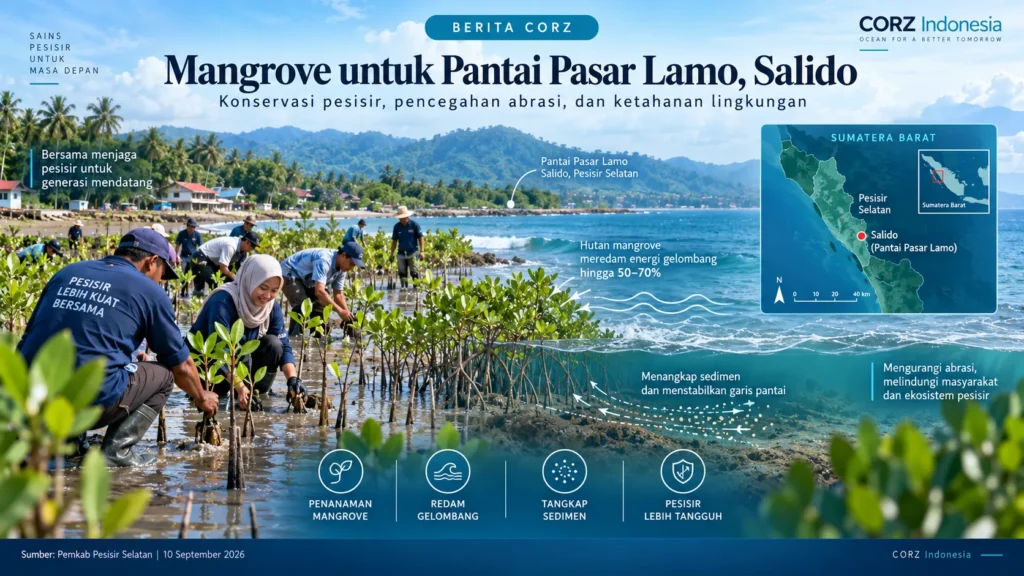
Mangroves are an important component of coastal ecosystems. In addition to providing habitat for marine and coastal organisms, mangrove vegetation can help reduce water energy, trap sediment, and—under suitable environmental conditions—contribute to shoreline stability.
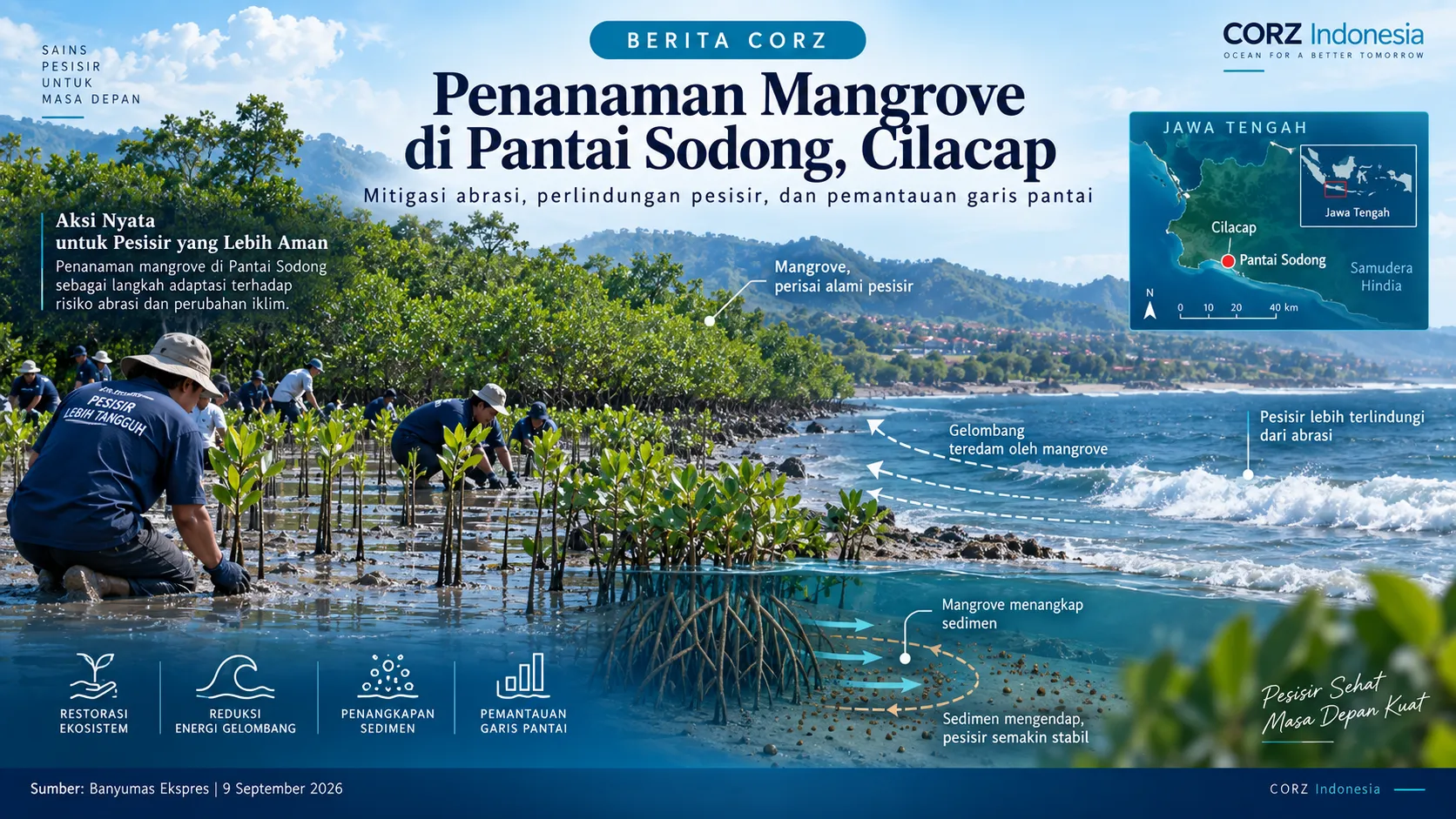
Banyumas Ekspres reported that 1,000 mangrove trees and 100 Liberica coffee trees were planted at Pantai Sodong, Karangbenda Village, Adipala District, Cilacap Regency, on 9 September 2026.
The mangrove planting formed part of efforts to strengthen coastal vegetation and help reduce the risk of abrasion along the shoreline.
How can CORZ contribute?
Mangrove planting is a positive coastal-management measure, but its effectiveness depends strongly on wave conditions, tidal elevation, sediment characteristics, currents, and long-term shoreline behaviour.
For this reason, rehabilitation programmes can be strengthened by first understanding the physical dynamics of the coastal environment.
CORZ Indonesia can support shoreline-change analysis using multi-temporal satellite imagery to identify areas experiencing erosion, relative stability, or accretion. These results can then be combined with wave, current, and sediment-transport modelling.
Such an integrated approach can help answer practical questions: Where are mangroves most likely to survive and function effectively? Which shoreline sections experience excessive wave energy? How does the coastline respond after rehabilitation has been implemented?
Satellite-based monitoring can also be continued after planting to evaluate vegetation development and coastal changes over time.
In this way, rehabilitation success is not assessed solely by the number of seedlings planted, but also by vegetation survival and measurable changes in coastal conditions.
CORZ Indonesia can support nature-based coastal protection by integrating remote sensing, shoreline analysis, and coastal-process modelling.