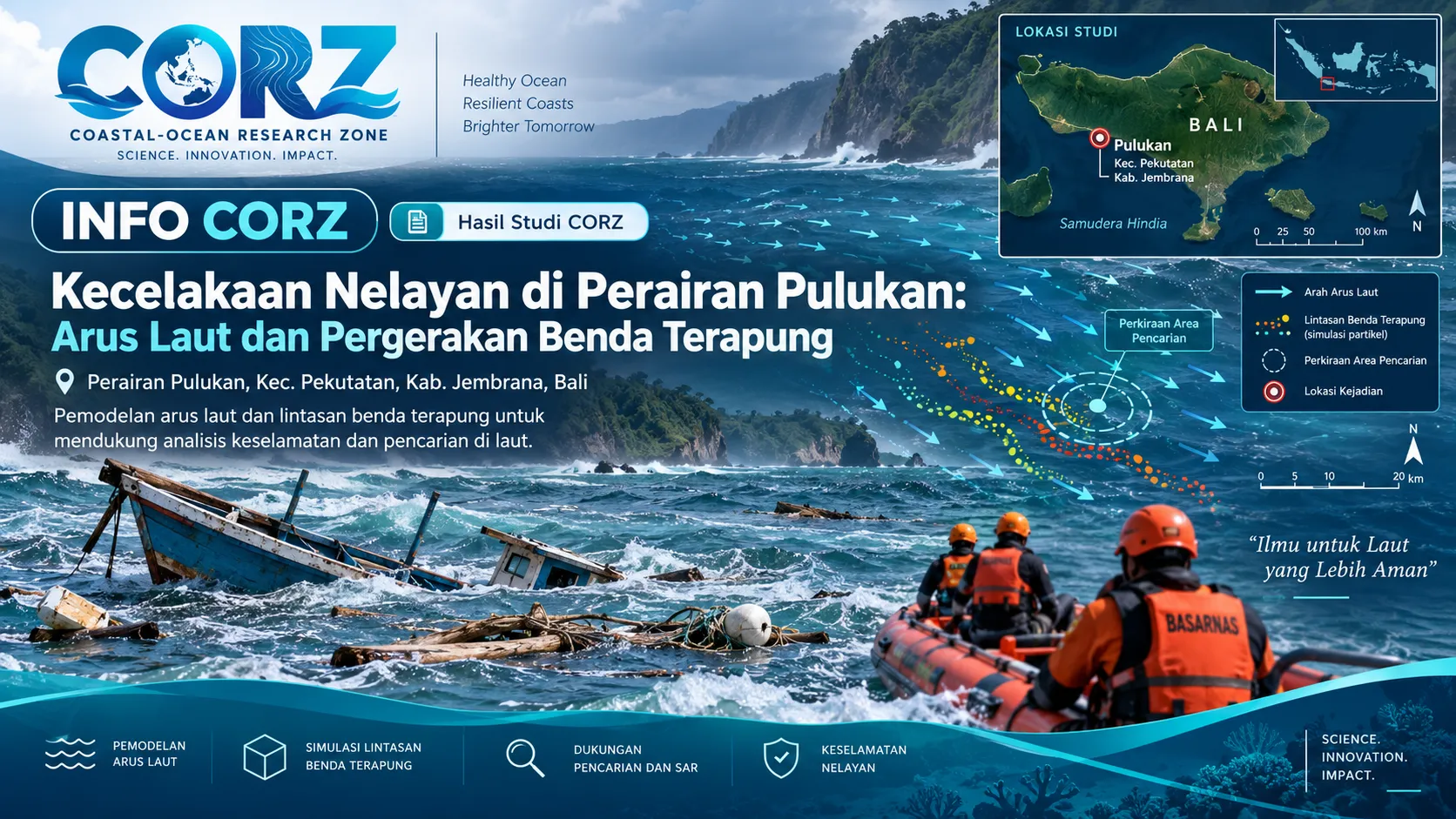
Location: Pulukan Waters, Pekutatan District, Jembrana Regency, Bali
A maritime accident in Pulukan Waters, Jembrana, once again highlights that fishermen’s safety depends not only on vessel condition and weather, but also on ocean dynamics and the presence of floating objects that may create navigation hazards. In the incident reported on 10 September 2026, a fiberglass fishing boat carrying three fishermen broke apart after striking a floating log. Two fishermen were rescued, while one fisherman was reportedly separated from his companions and was suspected of being carried away by ocean currents. Search and rescue teams subsequently conducted searches across both offshore and coastal areas.
Main news:
Liputan6 — Sampan Nelayan Pecah Dihantam Kayu di Perairan Pulukan, Satu Hilang
This incident illustrates the importance of understanding how ocean-current direction and velocity change over time. Floating objects—including logs, river-borne debris, vessel fragments, or other materials—do not move randomly. Their trajectories are influenced by tidal currents, wind-driven circulation, waves, regional ocean circulation, and the physical characteristics of the objects themselves. The same principles are also highly relevant when estimating the possible movement of a person or object drifting at sea.
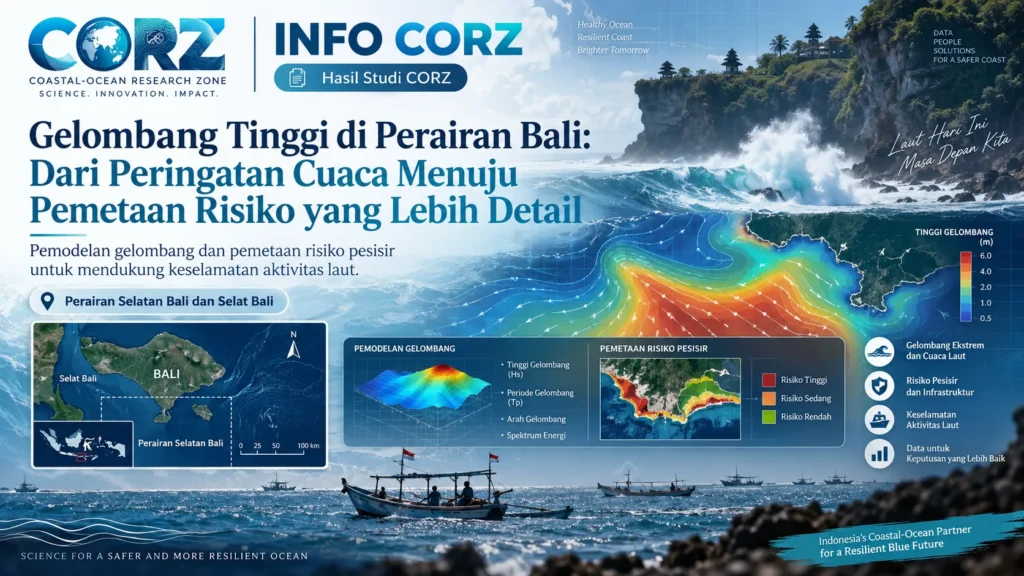
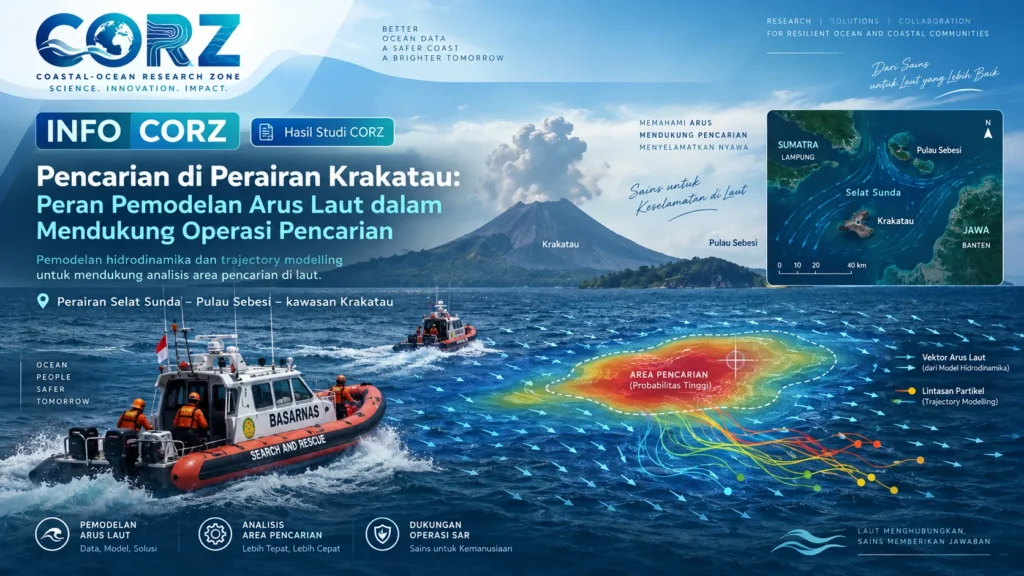
In this context, CORZ Indonesia can apply hydrodynamic modelling combined with particle tracking or Lagrangian drift modelling. A simulation can begin from the last known position of an object or person, after which multiple virtual particles are released and transported by current fields that vary across space and time.
Wind forcing, tides, waves, and uncertainty in the initial position can also be incorporated into the simulation. Rather than producing only a single predicted trajectory, this approach can generate a broader probability zone of movement, providing a more realistic representation of where an object may potentially travel.
The modelling results can be visualized through maps showing movement direction, travel distance, travel time, particle-density distribution, probability zones, and potential coastal landing areas. Such information may be used as supporting scientific information, together with field observations and official search-and-rescue procedures, to help identify areas that are oceanographically more relevant for further attention.
The Pulukan incident also offers a broader lesson. Drift modelling does not have to be applied only after an accident has occurred. It can also be used to investigate possible pathways of marine debris and floating materials entering fishing grounds or navigation routes.
Therefore, the study of ocean currents and floating-object movement can contribute not only to emergency response, but also to risk mitigation and safer small-scale maritime activities in coastal waters.
Related news:
detikBali — Sampan Fiber Pecah Dihantam Kayu di Perairan Pulukan, Satu Nelayan Hilang
https://www.detik.com/bali/berita/d-8657367/sampan-fiber-pecah-dihantam-kayu-di-perairan-pulukan-satu-nelayan-hilang
CORZ Indonesia — Science. Innovation. Impact.