CORZ Indonesia | Research & Studies
Before and After the Cooling Pond: How Does the Receiving Sea Respond?
Check out some other model outputs on YouTube @CORZIndonesia
Seawater is widely used as part of cooling systems for energy and industrial facilities.
After absorbing heat from an industrial process, cooling water may eventually be discharged back into the marine environment through an outfall at a temperature different from that of the receiving water.
At this point, an engineering process becomes an oceanographic problem.
The relevant question is no longer simply:
“What is the discharge temperature?”
It becomes:
Where will the heated water travel?
How will the thermal plume develop?
How do currents control its direction and dispersion?
Will West and East Monsoon conditions produce different responses?
And how does adding a cooling pond alter the thermal conditions before discharge into the sea?
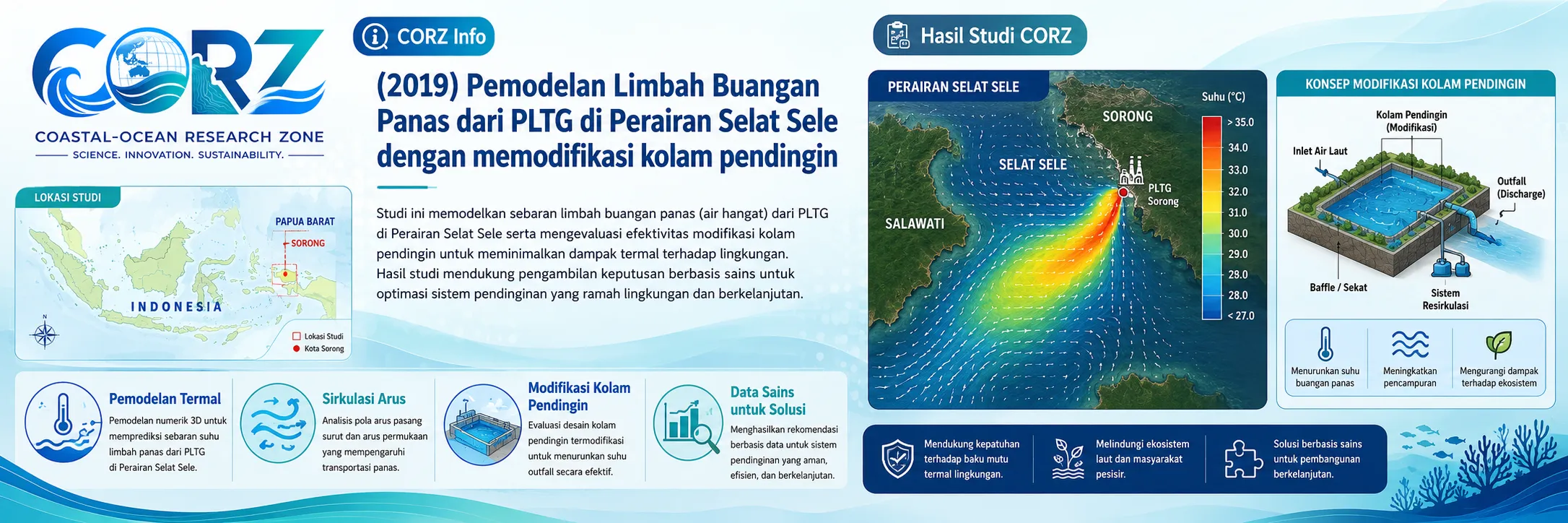
In 2019, CORZ Indonesia conducted Research & Studies involving thermal-discharge dispersion modelling in the Sele Strait.
Four modelling scenarios were evaluated:
- Before Cooling Pond — West Monsoon
• Before Cooling Pond — East Monsoon
• After Cooling Pond — West Monsoon
• After Cooling Pond — East Monsoon
Together, they create an integrated analytical framework:
COOLING SYSTEM × MONSOON × HYDRODYNAMICS × THERMAL DISPERSION
Sele Strait: A Strategic Marine Environment within an Industrial Region
The Sele Strait lies within the greater Sorong region, separating mainland Papua from Salawati Island.
Its surrounding waters form part of an environment associated with maritime transportation, petroleum operations, industrial development, and regional logistics.
In September 2019, Medcom reported the first shipment of approximately 3,700 barrels of mixed crude from the Salawati field to Pertamina's RU VII Kasim jetty in Sorong.
Medcom — First Salawati oil shipment to the Kasim Refinery, September 2019
On 11 October 2019, ANTARA reported the inauguration of the 523.7-hectare Sorong Special Economic Zone, designed to support industrial, logistics, and other economic activities in the region.
ANTARA — Sorong Special Economic Zone inaugurated, 11 October 2019
These reports were not reports about the CORZ study.
Their relevance is contextual: increasingly intensive coastal industrial activity strengthens the need to understand how receiving waters respond to industrial discharges.
Thermal Discharge: Heat Is an Environmental Load Too
Marine pollution assessment often focuses on petroleum, chemicals, or suspended sediment.
Temperature, however, is also an environmental parameter.
When water warmer than the surrounding sea is discharged through an outfall, it creates a:
THERMAL ANOMALY
that may develop into a:
THERMAL PLUME.
Conceptually:
INDUSTRIAL PROCESS
↓
HEAT TRANSFER
↓
COOLING WATER
↓
THERMAL DISCHARGE
↓
HYDRODYNAMIC TRANSPORT
↓
ADVECTION & DISPERSION
↓
TEMPERATURE DISTRIBUTION IN THE RECEIVING WATER
Thermal-plume behaviour is therefore controlled not by discharge temperature alone, but by the combined influence of current circulation, tides, season, ambient temperature, discharge conditions, mixing, and waterbody geometry.
Why Introduce a Cooling Pond?
A cooling pond provides additional opportunity for process water to lose heat before being discharged into the natural environment.
Conceptually:
WITHOUT A COOLING POND
PROCESS WATER
↓
OUTFALL
↓
SEA
compared with:
WITH A COOLING POND
PROCESS WATER
↓
COOLING POND
↓
HEAT DISSIPATION
↓
OUTFALL
↓
SEA
But whether that modification produces a meaningful change in the receiving-water thermal plume should not simply be assumed.
It should be evaluated numerically and, where possible, observationally.
Scenario 1 — Before Cooling Pond, West Monsoon
The first scenario represents:
BEFORE COOLING POND × WEST MONSOON.
It establishes one of the reference thermal conditions.
The model provides a framework for examining interactions among:
THERMAL SOURCE + CURRENT DIRECTION + CURRENT SPEED + TIDES + AMBIENT WATER + TIME
and the resulting spatial and temporal development of the thermal plume.
Scenario 2 — Before Cooling Pond, East Monsoon
The cooling configuration remains unchanged.
The seasonal forcing changes.
BEFORE COOLING POND × EAST MONSOON.
Comparison with the first scenario reveals the importance of seasonal hydrodynamics:
**SAME THERMAL SOURCE
- DIFFERENT SEASONAL CIRCULATION
= POTENTIALLY DIFFERENT THERMAL DISPERSION**
A fixed outfall does not necessarily generate the same spatial plume throughout the year.
The water receiving it changes.
Scenario 3 — After Cooling Pond, West Monsoon
The third scenario introduces the engineering modification:
AFTER COOLING POND × WEST MONSOON.
It allows a direct same-season comparison:
WITHOUT COOLING POND
versus:
WITH COOLING POND.
This comparison is particularly useful because the engineering effect can be assessed without simultaneously changing the seasonal scenario.
Scenario 4 — After Cooling Pond, East Monsoon
The fourth configuration completes the study:
AFTER COOLING POND × EAST MONSOON.
The modified cooling system is therefore evaluated under both major seasonal conditions.
The overall analysis can distinguish between:
ENGINEERING EFFECT
and:
SEASONAL EFFECT.
This is a major strength of the modelling design.
A 2 × 2 Thermal-Dispersion Experiment
The study can be expressed as a simple scenario matrix:
| West Monsoon | East Monsoon | |
| Before Cooling Pond | Scenario 1 | Scenario 2 |
| After Cooling Pond | Scenario 3 | Scenario 4 |
This structure supports three important comparisons.
Seasonal effect
West vs East
under the same cooling-system configuration.
Cooling-system effect
Before vs After
during the same season.
Final environmental performance
Evaluation of the modified system under both major monsoon regimes.
This provides considerably more insight than modelling only a single final configuration.
Hydrodynamics Is the Transport Engine of a Thermal Plume
Heat does not move independently through the ocean.
The water carrying that heat moves.
Therefore:
HYDRODYNAMICS DRIVES THERMAL TRANSPORT.
Current circulation influences advective movement.
Mixing and turbulent dispersion redistribute the thermal anomaly.
Interaction with surrounding water progressively changes plume temperature.
Conceptually:
HEATED WATER
×
CURRENT CIRCULATION
×
MIXING
×
TIME
↓
THERMAL PLUME.
This is why robust thermal-discharge assessment integrates hydrodynamic modelling with heat-transport modelling.
Same Strait, Different Seasonal Environment
In June 2019, ANTARA reported a BMKG weather warning that explicitly included the Sele Strait, Seget, Salawati, and surrounding Sorong areas.
ANTARA — BMKG weather warning including Sele Strait, June 2019
This report is not evidence of the CORZ modelling results.
It simply illustrates a fundamental point:
atmospheric forcing in this region is variable.
For coastal-ocean modelling, a monsoon is therefore not merely a calendar label.
It represents part of the changing physical forcing capable of influencing marine circulation and consequently thermal transport.
The Scientific Relevance Continued Beyond 2019
A particularly relevant independent scientific study was published in 2023, examining hydrodynamics and thermal dispersion in the Sele Strait around the Kasim process plant.
The research employed two-dimensional numerical modelling to evaluate intake–outfall conditions and temperature dispersion in the receiving waters.
This publication is not the CORZ 2019 study, and its scenarios or numerical outputs should not be treated as CORZ results.
Its value here is independent scientific context demonstrating that hydrodynamic–thermal interaction in the Sele Strait is a genuine and continuing environmental-engineering issue.
Beyond the Temperature at the Outfall
Measuring temperature directly at an outfall is important.
But receiving-water assessment needs to go further.
What happens downstream of the outfall?
How rapidly does the plume mix with ambient water?
Where does current circulation transport the heated water?
How does the response change through a tidal cycle?
Could warmer discharged water interact with an intake location?
This is the difference between:
OUTFALL TEMPERATURE
and:
RECEIVING-WATER THERMAL ASSESSMENT.
Numerical modelling connects the two.
From Temperature Maps to Engineering Performance
A thermal-model output may initially appear to be a coloured temperature map.
Its real value lies in the information behind the colours:
WHERE × WHEN × TEMPERATURE.
By comparing before-and-after configurations, modelling can provide a framework for evaluating:
- changes in thermal-plume distribution;
- changes in areas experiencing temperature anomalies;
- plume-transport pathways;
- seasonal differences between West and East Monsoons;
- interaction between cooling-system design and receiving waters; and
- areas requiring additional monitoring or optimisation.
The transformation is:
THERMAL MAP
↓
ENGINEERING & ENVIRONMENTAL PERFORMANCE INFORMATION.
Cooling-System Design Meets Ocean Dynamics
A cooling system may be designed on land.
Its environmental performance is ultimately determined where the discharge meets the sea.
The analytical pathway therefore becomes:
ENGINEERING DESIGN
↓
COOLING SYSTEM
↓
OUTFALL CONDITION
↓
HYDRODYNAMIC RESPONSE
↓
THERMAL DISPERSION
↓
ENVIRONMENTAL PERFORMANCE
CORZ modelling connects:
WHAT THE ENGINEERING SYSTEM RELEASES
with:
WHAT THE RECEIVING WATER DOES WITH IT.
From Modelling to Environmental Decision Support
Thermal-discharge modelling can support:
- Thermal Discharge Assessment
• Cooling Water System Evaluation
• Intake–Outfall Studies
• Refinery & Industrial Environmental Studies
• Power-Plant Environmental Assessment
• Environmental Impact Assessment
• Coastal Water-Quality Management
• Industrial Outfall Design
• Environmental Monitoring Design
It helps frame practical questions:
Does the cooling-system configuration require modification?
How do before and after conditions compare?
Is the response different between West and East Monsoons?
Where should environmental monitoring be prioritised?
Can the design be optimised before further implementation?
This is where:
SIMULATION → COMPARISON → PERFORMANCE ASSESSMENT → BETTER DECISION.
Cool the Water Before Asking the Ocean to Do It.
The ocean has an enormous capacity to transport, mix, and redistribute heat.
That capacity should not be interpreted as a reason to leave all cooling to the receiving environment.
A stronger engineering and environmental approach asks:
How much heat is being released?
How much can the engineered system reduce first?
and:
How does the ocean respond to what remains?
The 2019 Sele Strait study reflects the CORZ Indonesia Research & Studies approach:
Define the Thermal Source.
Model the Currents.
Compare the Monsoons.
Add the Cooling System.
Model Before and After.
Evaluate the Thermal Plume.
Support Better Environmental Decisions.
Because the key question should not simply be:
“Can the sea disperse the heat?”
It should be:
“How can we reduce the heat first—and understand what happens to the rest?”
CORZ Indonesia for Research & Studies
Thermal Discharge Modelling • Hydrodynamic Modelling • Cooling-System Assessment • Intake–Outfall Studies • Industrial Environmental Modelling • Environmental Impact Assessment
Coastal-Ocean Research Zone (CORZ) Indonesia provides research, modelling, analysis, and technical solutions for coastal and ocean environments.
YouTube: https://www.youtube.com/@CORZIndonesia
Website: https://corz.co.id
Email: info@corz.co.id
© 2026 CORZ Indonesia. All Rights Reserved.