CORZ Indonesia | Research & Studies
Understanding Where Heat Travels in the Sea
Check out some other model outputs on YouTube @CORZIndonesia
Seawater is never truly stationary.
Currents, tides, winds, water depth, and seasonal variations continuously move water masses from one location to another. When a coastal facility or power plant uses seawater for cooling and subsequently returns it to the marine environment at a different temperature, the critical question is not simply how warm the discharged water is.
The more important questions are:
Where will the warmer water travel?
How far could its thermal influence extend?
How will its temperature gradually return toward ambient conditions?
And will the dispersion pattern remain the same under different monsoon conditions?
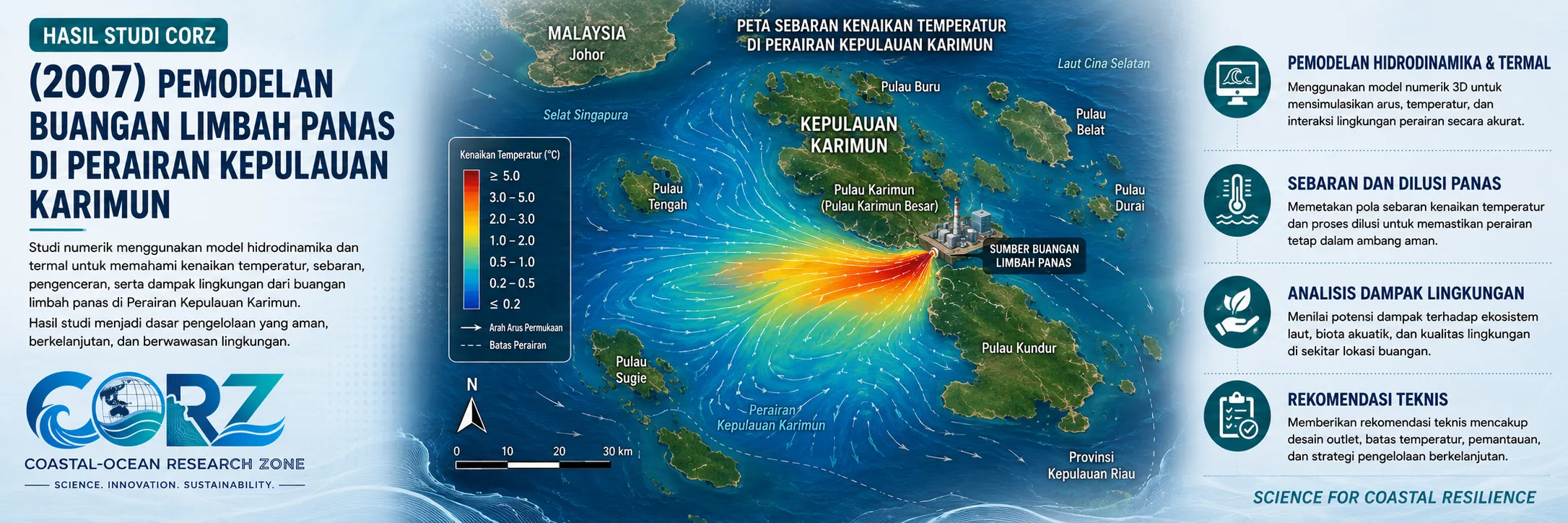
In 2007, CORZ Indonesia conducted Research & Studies involving numerical thermal-discharge modelling in the waters of the Karimun Islands, Riau Islands Province, representing two principal seasonal scenarios:
- Thermal Discharge Modelling — West Monsoon
- Thermal Discharge Modelling — East Monsoon
The study applied marine numerical modelling to investigate interactions among the thermal source, hydrodynamic circulation, heat transport, and seasonal variability.
Environmental Studies Amid Karimun's Development
The year 2007 marked an important period in the economic and industrial development of Karimun.
On 21 August 2007, the Indonesian government formally designated Karimun, together with Batam and Bintan, as part of a Free Trade and Free Port Zone. ANTARA reported that the policy was intended to strengthen economic activities including trade, maritime industries, manufacturing, transportation, and related sectors.
ANTARA — Government establishes Batam, Bintan and Karimun free-trade zones
In October of the same year, detikFinance reported a substantial increase in investment commitments across the Batam–Bintan–Karimun (BBK) region following implementation of the free-trade-zone regulations, with manufacturing representing a significant portion of the investment.
detikFinance — Investment commitments in Batam, Bintan and Karimun
The following year, The Jakarta Post reported plans for a privately developed 30 MW power-generating station as part of Karimun's expanding infrastructure.
The Jakarta Post — Karimun Builds Vital Infrastructure
ANTARA also reported in January 2008 that PLN had signed an EPC contract for a 2×7 MW steam power plant in Tanjung Balai Karimun.
ANTARA — PLN Signs EPC Contracts for New Power Plants
These reports do not describe the CORZ study itself. Rather, they provide relevant historical context for the expansion of industrial and energy infrastructure in Karimun during the period.
Within such a rapidly developing coastal environment, understanding the response of marine waters to industrial activities becomes increasingly important.
Thermal Discharge: More Than an Outfall Location
Cooling water does not remain at the discharge point once it enters the sea.
It is transported, mixed, and dispersed by the surrounding hydrodynamic system.
Conceptually, the process can be described as:
THERMAL SOURCE
↓
HYDRODYNAMIC CIRCULATION
↓
ADVECTION & DISPERSION
↓
THERMAL PLUME
↓
HEAT DISSIPATION
↓
RECEIVING WATERS
Knowing the location of an outfall is therefore only the beginning.
Numerical modelling is required to understand how the thermal plume evolves over space and time and how marine circulation controls its direction and dispersion characteristics.
CORZ Research: Connecting Hydrodynamics with Heat Transport
For the Karimun Islands study, CORZ applied a modelling approach that connects two principal components:
marine hydrodynamics and heat transport.
The hydrodynamic model represents how water masses circulate, while the thermal-transport component represents how temperature anomalies originating from a discharge source are transported and dispersed through that circulation system.
The simulations provide a framework for evaluating:
- thermal-plume direction;
- spatial distribution of temperature changes;
- influence of current circulation on heat transport;
- attenuation of temperature anomalies away from the source;
- marine areas potentially influenced by thermal discharge; and
- differences between West and East Monsoon dispersion patterns.
The modelling results provide a spatial and temporal representation of the receiving-water response to a thermal source, allowing processes that are difficult to capture comprehensively through point measurements alone to be examined across the wider marine system.
West Monsoon: When the Ocean Selects the Pathway
The West Monsoon simulation was developed to investigate how hydrodynamic conditions during this season influence the transport of heat from the source into the receiving waters.
The model helps illustrate how water with a different temperature is transported by currents, forms a particular dispersion pattern, and gradually interacts with surrounding ambient seawater.
The modelling question therefore moves beyond:
“What is the temperature at the discharge point?”
toward:
“How does that thermal influence evolve after entering the marine environment?”
East Monsoon: Same Source, Different Ocean
The scenario was subsequently modelled for the East Monsoon.
This comparison represents one of the key strengths of the CORZ study.
Indonesia's monsoonal system produces seasonal changes in winds and marine circulation. Consequently, an identical discharge source does not necessarily generate an identical thermal plume throughout the year.
The principle is straightforward but important:
**SAME SOURCE
- DIFFERENT SEASON
- DIFFERENT HYDRODYNAMICS
= DIFFERENT THERMAL DISPERSION**
Using only one seasonal condition may therefore provide an incomplete representation of environmental response.
Comparing the West Monsoon and East Monsoon provides a more comprehensive perspective on how changing marine conditions influence thermal transport.
Why Do Marine Temperature Changes Matter?
Temperature is one of the fundamental parameters of the marine environment.
Changes in temperature can influence the physical and chemical properties of seawater and the environmental conditions experienced by aquatic organisms. For coastal facilities using seawater for cooling, it is therefore important to understand not only the discharge temperature but also how rapidly that temperature difference is diluted and what area of the receiving waters may be influenced.
Thermal-discharge modelling can support technical evaluation of questions such as:
Where should an outfall be located?
In which direction could the thermal plume travel?
How effectively will discharged water mix with surrounding seawater?
Which areas may require more intensive monitoring?
Should the intake–outfall configuration be evaluated?
How does the system respond under different seasonal conditions?
These questions are relevant to Environmental Impact Assessment (EIA/AMDAL), cooling-water system design, outfall planning, coastal-industry environmental management, and marine-water-quality monitoring.
From Data to Models, from Models to Decisions
Field observations provide essential information about marine conditions at specific locations and times.
Numerical modelling adds another dimension.
It enables physical processes to be examined across:
SPACE × TIME × SCENARIO
By combining environmental data, boundary conditions, source characteristics, and marine dynamics, modelling can transform complex physical processes into information that can support planning and environmental decision-making.
For CORZ Indonesia, the workflow can be expressed as:
FIELD & ENVIRONMENTAL DATA
↓
HYDRODYNAMIC MODEL
↓
THERMAL TRANSPORT MODEL
↓
WEST & EAST MONSOON SCENARIOS
↓
THERMAL PLUME ANALYSIS
↓
ENVIRONMENTAL DECISION SUPPORT
A 2007 Study with Long-Term Relevance
The value of this study extends beyond the year in which it was conducted.
Karimun subsequently developed further as a free-trade, industrial, port, offshore-fabrication, and energy centre. These developments demonstrate why understanding the interaction between coastal development and the surrounding marine system remains relevant.
Thermal-discharge modelling illustrates how ocean modelling can be applied proactively:
understanding potential environmental responses before they become environmental problems.
Rather than waiting for environmental change to occur and investigating it afterwards, science and numerical modelling can help industries, planners, and decision-makers design, evaluate, and manage coastal activities more responsibly.
Model the Heat Before It Becomes an Impact.
The ocean moves.
Heat moves with it.
And the seasons can change the pathways of both.
The Karimun Islands study reflects a fundamental principle of the CORZ Indonesia approach:
Understand the Source.
Model the Current.
Track the Heat.
Compare the Seasons.
Support Better Environmental Decisions.
CORZ Indonesia for Research & Studies
Hydrodynamic Modelling • Thermal Discharge Modelling • Advection–Dispersion • Cooling-Water Studies • Environmental Impact Assessment • Coastal & Ocean Modelling
Coastal-Ocean Research Zone (CORZ) Indonesia provides research, modelling, analysis, and technical solutions for coastal and ocean environments.
YouTube: CORZ Indonesia — @CORZIndonesia
Website: CORZ Indonesia — corz.co.id
Email: info@corz.co.id
© 2026 CORZ Indonesia. All Rights Reserved.