CORZ Indonesia | Research & Studies
Understanding Where Pollutants Travel Before Their Impacts Occur
Check out some other model outputs on YouTube @CORZIndonesia
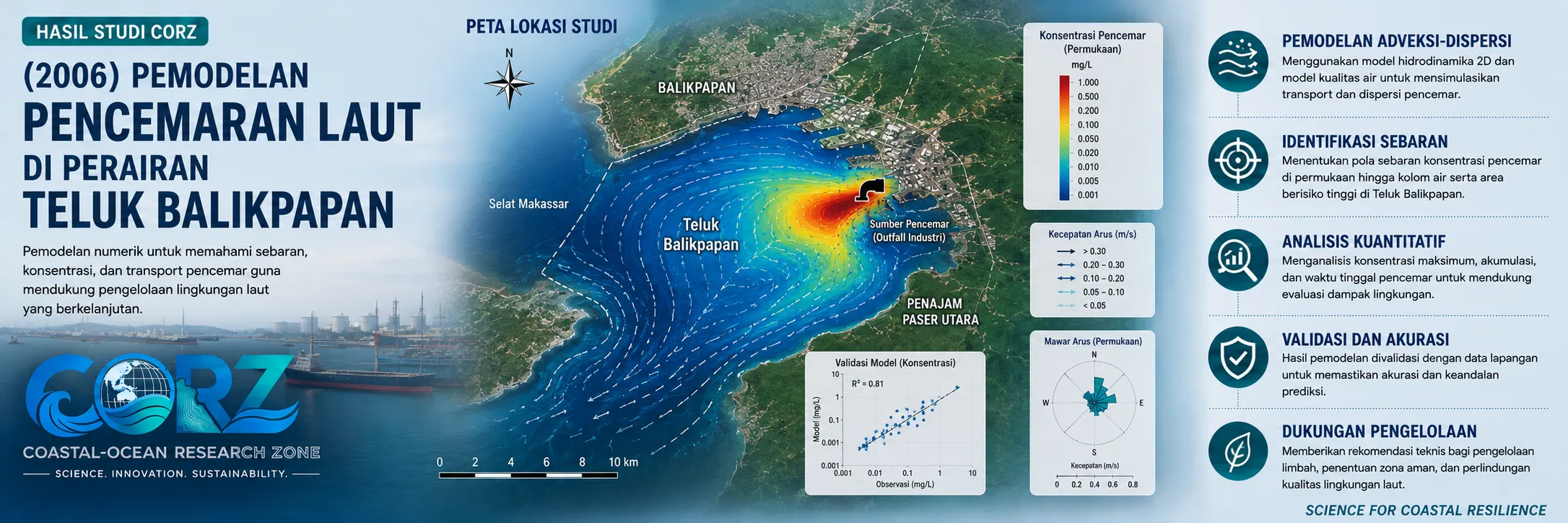
Balikpapan Bay is a strategically important coastal environment in East Kalimantan where ports, industry, energy infrastructure, marine transportation, fisheries, mangrove ecosystems, and coastal communities coexist within one dynamic marine system.
In such an environment, understanding marine pollution requires much more than identifying where a pollutant enters the water.
The more important questions are:
Where will the pollutant travel?
How widely could it disperse?
Where could sediment accumulate or erode?
How might the pattern change between the West and East Monsoon seasons?
And how could spilled oil change while moving through the marine environment?
In 2006, CORZ Indonesia conducted a comprehensive series of Research & Studies involving numerical marine-pollution modelling in Balikpapan Bay to investigate these questions.
The study integrated sediment transport, pollutant dispersion, seabed change, and oil-spill dynamics, with simulations representing both the West Monsoon and East Monsoon conditions.
One Bay, Multiple Interconnected Processes
Marine pollution is not static.
Material released from a point source may be transported by currents, diluted and dispersed, interact with suspended or bottom sediments, become deposited on the seabed, or move toward other parts of the coastal environment.
Oil spills involve additional complexity. Oil can spread over the water surface, experience changing concentrations and exposure patterns, and undergo emulsification through interactions between oil, seawater, and marine dynamics.
CORZ therefore approached marine pollution as an interconnected system of physical processes, rather than treating it simply as a discharge from a single location.
Eight Analytical Components × Two Monsoon Seasons
The CORZ study incorporated modelling of eight principal environmental components, with each component simulated under West and East Monsoon conditions.
- Net Sediment-Mass Accumulation: Deposition and Erosion
Numerical modelling was conducted to investigate the spatial distribution of net sediment mass deposited or eroded from several point-source scenarios.
Simulations under West and East Monsoon conditions provided a framework for examining how seasonal hydrodynamic variations could influence whether an area tends to behave as a:
depositional zone ↔ transport zone ↔ erosion zone.
This information is important when assessing potential changes in the seabed environment and identifying locations where material may preferentially accumulate.
- Sediment-Particle Concentration
CORZ modelled the distribution of sediment-particle concentrations originating from multiple point sources during both monsoon seasons.
This approach provides a spatial representation of suspended-material transport and links individual sediment sources with the hydrodynamic processes responsible for transporting them.
The relevance of sedimentation in Balikpapan Bay later became a matter of public concern. In 2011, ANTARA reported significant sedimentation in the bay and its potential implications for marine organisms and port activities. ANTARA — Sedimentation threatens livelihoods in Balikpapan Bay
- Oil-Spill Concentration Distribution
A major component of the study involved modelling oil-spill concentrations from multiple point sources under West and East Monsoon conditions.
The simulations were designed to represent how oil released at a particular location could be transported and dispersed by the surrounding marine environment.
Scenario modelling allows an important question to be explored:
If oil enters the sea at a particular location, where could it travel and how could its concentration pattern evolve?
The strategic relevance of this capability became especially visible years later.
In March–April 2018, a major oil spill occurred in Balikpapan Bay. Reuters reported that a ruptured underwater pipeline caused the spill and prompted a major clean-up operation. Reuters — Indonesia state firm says oil spill due to cracked underwater pipeline
The Jakarta Post subsequently reported substantial impacts on the marine environment and coastal communities and described the emergency response surrounding the incident. The Jakarta Post — Balikpapan oil spill: What we know and don't know
- Pollutant-Waste Dispersion
Marine pollution is not limited to petroleum.
CORZ also modelled the dispersion of pollutant waste released from multiple point sources, covering both West and East Monsoon scenarios.
This provides a framework for analysing how discharged substances can undergo advection and dispersion, move away from their source, and develop different concentration patterns within receiving waters.
Such modelling is relevant to the assessment of industrial outfalls, coastal facilities, ports, and other activities with the potential to discharge substances into the marine environment.
Environmental pressure on Balikpapan Bay has been documented beyond oil-spill incidents. In 2009, The Jakarta Post reported declining water quality and identified oil, gas, and coal activities among the pressures contributing to pollution in the bay. The Jakarta Post — Oil and coal mining firms pollute Balikpapan Bay
- Changes in Seabed Sediment Thickness
CORZ also modelled changes in seabed sediment thickness resulting from material introduced through different point-source scenarios.
This moves the analysis beyond suspended sediment in the water column.
It examines how transported material can ultimately translate into physical changes at the seabed.
Such information can be highly relevant to studies involving:
sedimentation • navigational depth • dredging • benthic environments • coastal infrastructure • port development.
- Changes in Deposited Sediment Mass
The change in deposited sediment mass was also modelled to investigate the spatial distribution of material ultimately settling on the seabed.
Comparing West and East Monsoon simulations provides an analytical basis for understanding how seasonal hydrodynamic conditions may influence the location and intensity of deposition.
Going Beyond “Where Does the Oil Go?”
For oil-spill assessment, CORZ extended the modelling beyond simple spatial distribution.
- Percentage of Oil-Spill Exposure
CORZ modelled the spatial distribution of oil-spill exposure percentages from several point-source scenarios during the West and East Monsoon seasons.
This approach allows the simulations to examine not only where oil may be present but also the spatial characteristics of potential exposure.
Understanding which areas could become exposed is important for prioritising monitoring, protecting environmentally sensitive areas, and developing response strategies.
The 2018 incident demonstrated the real-world importance of exposure assessment. ANTARA reported that an evaluation by Indonesia's Ministry of Environment and Forestry identified contaminated coastal areas around Balikpapan Bay and called for more detailed studies to support restoration planning. ANTARA — Environment Ministry evaluates Balikpapan Bay oil-spill impacts
Indonesian media also reported impacts on marine organisms and fishing activities following the spill. detik — Marine life affected by the Balikpapan oil spill
- Oil-Spill Emulsification Percentage
Oil released into the marine environment does not necessarily retain the same physical characteristics as when it was first discharged.
Interaction with seawater and marine dynamics may lead to emulsification.
CORZ therefore also modelled oil-spill distribution based on the percentage of oil emulsification, under both West and East Monsoon conditions.
This adds another important dimension to oil-spill modelling:
not only where the oil goes, but also how the oil changes while it moves.
West Monsoon vs East Monsoon: Why Model Both?
Indonesia's monsoonal climate produces seasonal changes in winds and marine circulation.
Consequently, the same pollutant released from the same source does not necessarily produce an identical environmental response throughout the year.
This is why the CORZ simulations addressed both major monsoon conditions.
The approach enables comparison of:
same source → different hydrodynamics → different transport pathway → different potential exposure.
The assessment therefore moves beyond the question:
“Where is the source?”
toward the more meaningful question:
“What could happen to the pollutant under different ocean conditions?”
Sixteen Modelling Outputs, One Integrated Environmental Picture
Overall, the Balikpapan Bay study comprised 16 thematic modelling outputs—eight environmental components simulated for both West and East Monsoon conditions:
01 — Net deposited/eroded sediment-mass accumulation — West Monsoon
02 — Net deposited/eroded sediment-mass accumulation — East Monsoon
03 — Sediment-particle concentration — West Monsoon
04 — Sediment-particle concentration — East Monsoon
05 — Oil-spill concentration — West Monsoon
06 — Oil-spill concentration — East Monsoon
07 — Pollutant-waste dispersion — West Monsoon
08 — Pollutant-waste dispersion — East Monsoon
09 — Change in seabed sediment thickness — West Monsoon
10 — Change in seabed sediment thickness — East Monsoon
11 — Change in deposited sediment mass — West Monsoon
12 — Change in deposited sediment mass — East Monsoon
13 — Percentage of oil-spill exposure — West Monsoon
14 — Percentage of oil-spill exposure — East Monsoon
15 — Percentage of oil-spill emulsification — West Monsoon
16 — Percentage of oil-spill emulsification — East Monsoon
Together, these simulations form a more complete representation of the pathway:
SOURCE → HYDRODYNAMICS → TRANSPORT → DISPERSION → DEPOSITION/EROSION → EXPOSURE → ENVIRONMENTAL IMPACT
From Numerical Models to Environmental Decision Support
For CORZ Indonesia, marine-pollution modelling is about much more than producing colourful animations of pollutants moving through the sea.
Its real value is in transforming complex environmental processes into information that can support decisions.
Numerical modelling can help identify:
- potential pollutant-transport pathways;
- areas potentially exposed to contamination;
- seasonal differences in dispersion;
- sediment deposition and erosion tendencies;
- changes in seabed conditions;
- oil-spill behaviour; and
- connections between pollution sources and receiving environments.
Such information can support Environmental Impact Assessment (EIA/AMDAL), oil-spill contingency planning, outfall siting, coastal-industry assessments, port planning, sediment-management strategies, protection of sensitive ecosystems, and marine-pollution emergency response.
A 2006 Study with Continuing Relevance
The CORZ modelling study was undertaken in 2006.
Three years later, national media reported environmental-quality concerns in Balikpapan Bay. In 2011, sedimentation attracted attention because of its implications for ecosystems and maritime activities. Then, in 2018, a major oil-spill incident demonstrated how rapidly marine contamination can develop into an environmental, economic, safety, and social emergency.
The 2006 CORZ study did not predict those later events.
Rather, subsequent developments demonstrate why the capability to model sediment, pollutants, and oil spills before environmental impacts occur is an important component of modern coastal and marine management.
Model the Pollution Before It Becomes an Impact.
The ocean is always moving.
Pollutants move with it.
Understanding the ocean therefore requires more than knowing what enters the water. It requires understanding where that material may travel, how it may change, where it may accumulate, and what could ultimately be exposed.
That is the essence of the CORZ Indonesia approach:
Understand the Source.
Model the Transport.
Predict the Dispersion.
Support Better Environmental Decisions.
CORZ Indonesia for Research & Studies
Marine Pollution Modelling • Oil Spill Modelling • Sediment Transport • Advection–Dispersion • Environmental Impact Assessment • Coastal & Ocean Modelling
Coastal-Ocean Research Zone (CORZ) Indonesia provides research, modelling, analysis, and technical solutions for coastal and ocean environments.
YouTube: https://www.youtube.com/@CORZIndonesia
Website: https://corz.co.id
Email: info@corz.co.id
© 2026 CORZ Indonesia. All Rights Reserved.