CORZ Indonesia | Research & Studies
From the 2004 Aceh Disaster to Understanding Future Tsunami Risk
Check out some other model outputs on YouTube @CORZIndonesia
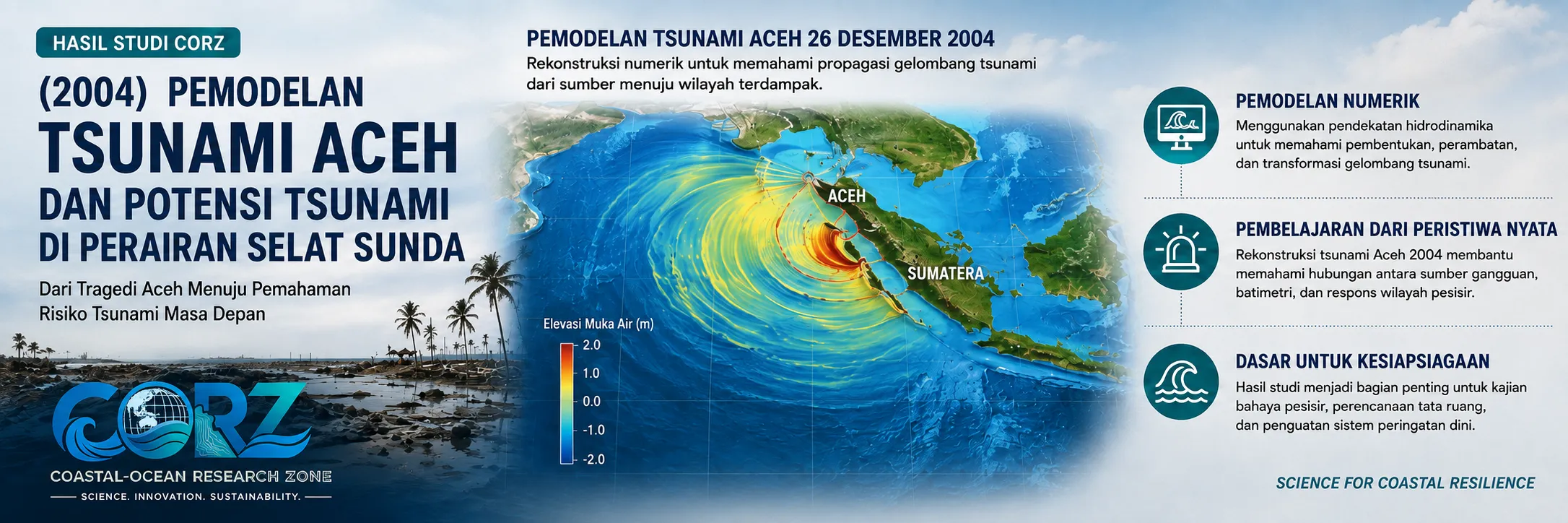
The tsunami that struck Aceh on 26 December 2004 became one of the most significant natural disasters in Indonesia's modern history. A massive offshore earthquake triggered a destructive tsunami across Aceh and the Indian Ocean region, leaving an extraordinary humanitarian, environmental, and infrastructural impact.
Two decades later, the disaster remains a powerful reminder of the importance of science, numerical modelling, early-warning systems, preparedness, and coastal planning. Associated Press revisited the disaster and its lasting lessons on its twentieth anniversary 20 years since the 2004 Indian Ocean tsunami – Associated Press, while Reuters reported on Indonesia's continued efforts to strengthen tsunami warning systems and disaster preparedness in Aceh. Indonesia improves warning system 20 years after the Aceh tsunami – Reuters
Within this context, Coastal-Ocean Research Zone (CORZ) Indonesia places tsunami modelling as an important component of its Research & Studies activities—using numerical approaches to investigate how tsunami waves may be generated, propagate across the ocean, transform in shallower waters, and potentially affect coastal environments.
CORZ Research and Modelling Activities
The CORZ tsunami studies include:
- Numerical Modelling of the 2004 Aceh Tsunami
CORZ conducts numerical reconstruction of the 2004 Aceh tsunami to investigate the characteristics of tsunami propagation from its source toward affected coastal areas.
Reconstructing historical events provides an opportunity to examine relationships among the source mechanism, bathymetric conditions, wave propagation, and coastal response.
More importantly, historical modelling allows lessons from past disasters to be transformed into quantitative knowledge that can support better understanding of future coastal hazards.
- Tsunami Scenario Modelling from Potential Earthquakes South of the Sunda Strait
CORZ also develops tsunami modelling scenarios associated with potential earthquake sources south of the Sunda Strait.
This region deserves particular attention because it forms part of Indonesia's highly active tectonic environment and lies close to densely populated coastlines and strategically important infrastructure.
The issue remains highly relevant today. Indonesia's Meteorological, Climatological, and Geophysical Agency (BMKG) has highlighted the Sunda Strait megathrust as an earthquake source whose maximum potential magnitude needs to be considered in hazard assessments. Understanding the tsunami potential of the Sunda Strait Megathrust – Kompas.com
Other reporting has highlighted research scenarios concerning tsunami propagation from the region and the need for continued coastal preparedness. Tsunami potential and Indonesia's megathrust zones – Kompas.com
CORZ tsunami modelling should not be interpreted as predicting when an earthquake or tsunami will occur. Instead, numerical modelling addresses another critical question:
If a particular source scenario occurs, how could the resulting tsunami propagate, and which coastal areas may require greater attention?
- Tsunami Modelling Using a Boussinesq Wave Model in the Waters North of Java
As part of its tsunami research development, CORZ also conducts simulations using a Boussinesq Wave modelling approach in the waters north of Java.
Boussinesq-type modelling provides a framework for examining long-wave behaviour and wave transformations as waves enter progressively shallower environments. For tsunami studies, parameters such as wave propagation patterns, water-level variations, wave transformation, bathymetric influence, and coastal configuration can contribute valuable information for understanding local hazard characteristics.
The use of multiple numerical approaches and scenarios reflects CORZ's commitment to developing assessments that are more comprehensive, physically based, and quantitatively supported.
Turning Data into Understanding—and Understanding into Preparedness
At CORZ Indonesia, numerical modelling is about much more than producing maps, graphs, or animations.
Behind every simulation lies a much larger question:
How can science help us understand the ocean before an extreme event occurs?
Through the reconstruction of the 2004 Aceh tsunami, simulations of potential tsunami scenarios south of the Sunda Strait, and the development of Boussinesq wave modelling in the waters north of Java, CORZ continues to explore how ocean modelling can contribute to coastal-hazard assessment, mitigation planning, strategic-area evaluation, disaster-scenario development, and improved coastal resilience in Indonesia.
Indonesia's experience since the 2004 Aceh tsunami demonstrates that scientific capability and preparedness must continue to evolve. Reuters reported that tsunami-warning infrastructure and evacuation preparedness in Aceh have continued to be strengthened two decades after the disaster.
The past gives us data.
Modelling helps us understand it.
And understanding gives us an opportunity to be better prepared for the future.
CORZ Indonesia for Research & Studies
Research • Modelling • Analysis • Technical Solutions
Coastal-Ocean Research Zone (CORZ) Indonesia provides research, modelling, analysis, and technical solutions for coastal and ocean environments.
Email: info@corz.co.id
© 2026 CORZ Indonesia. All Rights Reserved.